Sacrament Banner with the Lamb of God
Church textiles are scarcely represented in the collection. Fortunately, in 2019, a sacramental banner was donated by the Redemptorist Fathers of the Monastery in Wittem.
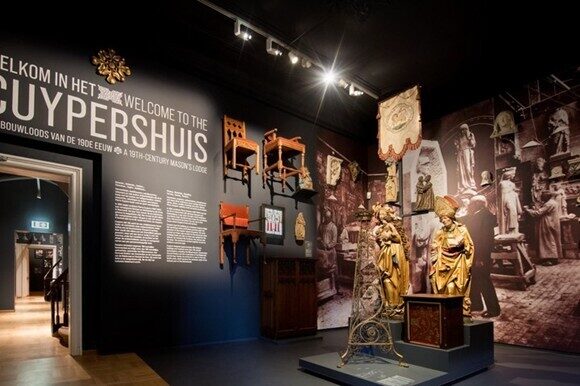
The sacramental banner was made around 1890–1910 in the Stoltzenberg workshop and is now on display in the “Welcome” room at the Cuypershuis. The central medallion depicts the Lamb of God. Blood flows from the Lamb’s side into a chalice, symbolizing the suffering of Christ. Surrounding it is the text: “Ecce Agnus Dei, Ecce qui tollit peccata mundi,” meaning: “Behold the Lamb of God who takes away the sins of the world.”
The image is painted on silk. The lines are further emphasized with embroidery. The medallion is mounted on white damask, which is edged with two-tone fringe and a cord with tassels. Mounted on a pedestal, it could be placed in the church.
In October 1852, the firm Georges, Cuypers, and Stoltzenberg was founded in Roermond: “Workshops for Christian Sculpture, Church Paintings, and Church Furniture in All Styles.” Georges soon left on good terms, but Cuypers and Stoltzenberg continued. Since 1840, François Stoltzenberg had run a successful firm that supplied “church ornaments, vestments, banners, gold, silver, and copperwork, etc.” A joint catalog was published by both firms in 1890. That catalog lists similar banners under nos. 27 and 28.
Banners with painted ornaments, without a base, were available starting at 20 guilders and up. A banner with silk fringes and multicolored silk embroidery cost at least 10 guilders more. An additional 4 to 10 guilders was charged for the inclusion of the bases.
The sacramental banner is on display in the Limburg Showroom of the Limburg Social History Center (SHCL). As part of the DRAPO project, Limburg association flags and banners are being cataloged.