The Filing Cabinet
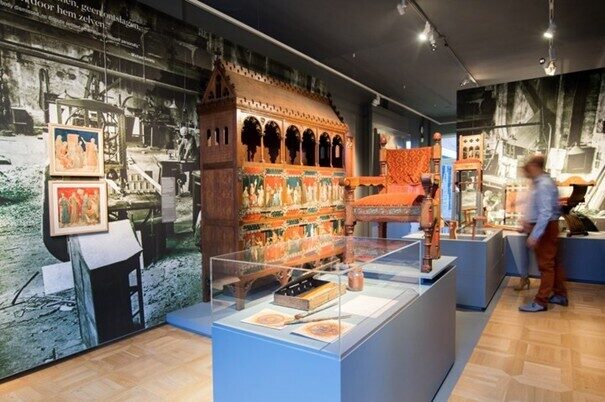
A highlight of the Cuypershuis collection. It stands out not only because of its size, but especially because of the beautifully painted scenes on its doors. This installment of “Object with a Story” focuses on the filing cabinet designed by Pierre Cuypers. The cabinet is shaped like a building. It is topped by a roof surrounded by a border of battlements. Beneath that is a sort of low gallery with round arches. The cabinet itself—lockable with 12 painted doors arranged in two rows one above the other—is located below that. Its design is inspired by a medieval example: the sacristy cabinet in Noyon Cathedral.
In 1858, Cuypers wrote in the magazine “De Dietsche Warande” about the importance of the architect and his leadership over the collaborating craftsmen in bringing a building to fruition. This principle is reflected in the depictions on the cabinet. The upper row of doors depicts the liberal arts: astronomy, geometry, grammar, logic, poetry, and music. The lower doors depict the applied arts: stone carving, masonry, stained glass, stonework, and panel painting. The designs created by Pierre Cuypers for the depictions of “poetry” and “music” have been preserved in the Cuypershuis collection. They can be admired next to the filing cabinet in the permanent exhibition.
The cabinet was designed by Pierre Cuypers around 1893 for De Haar Castle and was crafted by his art workshops. The iron hardware was also made in Roermond. The painting was done by Joseph Lücker. Among the collection of glass negatives donated by the Cuypers family in 2020 is a beautiful photograph of Pierre Cuypers, in which he appears to be proudly posing in front of the filing cabinet. The photo was taken in the Cuypers Room of what is now the Cuypers House, around 1910.